Same daemon on your machine. The meeting point is yours too.
Hubcode runs an open-source daemon on your machine and reaches it through a relay Hubcode hosts. Cordane runs a worker on your machine that dials out to a hub you host — where your whole team's board lives — and a ticket drives the agent from there. From a browser, or a phone.
Hubcode is an app with a relay; Cordane is a hub with a board. The line is drawn below.A ticket, a worktree, a real agent run — on your hub.
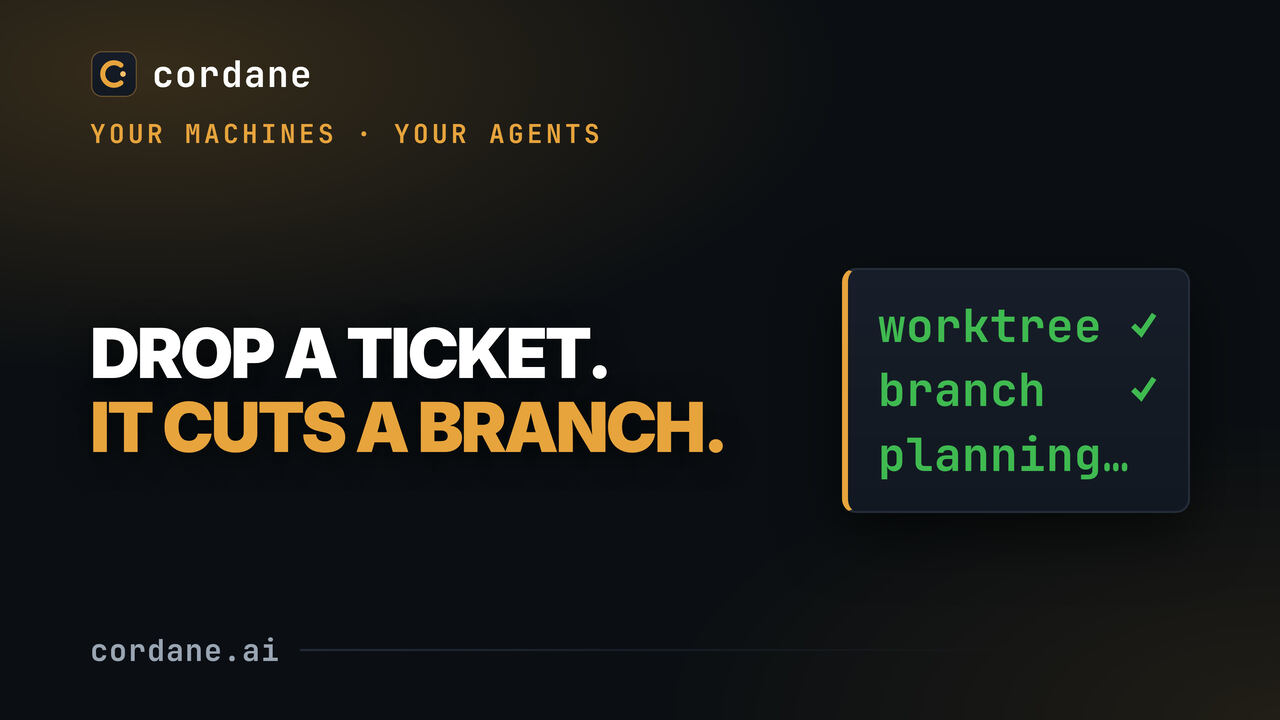
Plan starts the work — worktree, branch, space — and hands the agent the ticket inside that worktree. What you see is whatever Claude Code actually produced on the day it was filmed, on a machine that dialed out to a self-hosted hub.
Both put a daemon on your machine. They differ in what it connects to.
Hubcode's line is "The self-hosted control plane for your coding agents", and its daemon really does keep your code on your machine. The difference is what's on the other end of the connection — a relay you borrow, or a hub you own — and what lives there.
Daemon, apps, and a relay they host.
- A local daemon manages your agents; native desktop and mobile apps, a web client and a CLI drive it. Chat GUI over Claude Code, Codex, opencode, Copilot and Pi; kanban per worktree; on-device voice; MCP servers and skills.
- To reach the daemon from elsewhere, the recommended path is Hubcode's hosted relay — outbound from the daemon, end-to-end encrypted, no open ports. Otherwise a direct connection on your LAN or over a VPN like Tailscale.
- App, daemon and CLI are AGPL-3.0. Free with your own keys; Pro and Enterprise add the Hubtool agent, org messaging, more members and shared workspaces.
Worker, browser, and a hub you own.
- A worker on each machine dials out to a hub you self-host (or we host, with your workers still on your side). No vendor relay in the path; the hub is also where the board, the terminals and the team are.
- Agents run in a real terminal — Claude Code's own interface, your dotfiles — or headless from a ticket: worktree, branch, plan, implement, review, state on the card.
- One board per project for the whole team, private workers per member, GitHub sign-in behind an allowlist; dev servers get stable URLs and public share links.
- Browser only — no native apps, no chat GUI, no voice. Free forever to self-host on the Community tier; the hub isn't open source, the deploy config is MIT.
Your hub, your machines, one board between them.
The relay question goes away because the thing the worker dials into is already yours. Everything else — the board, terminals, previews — rides that same connection.
Run the hub, once
Two containers on a small VPS behind your domain, or the managed cloud. It's one Go binary and a SQLite file — no relay account, no per-device pairing. Sign in with GitHub; the first account is the admin.
Each member enrolls their own machine
One command on a laptop, a desktop behind CGNAT, an office box. It connects outward — no port 22, no VPN — and stays private to its owner while the board is shared with the team.
Drop a ticket, or open a shell
A ticket cuts a git worktree, runs setup hooks and hands the work to Claude Code, Codex, opencode or pi, with the result on the card. Or open a space and run the CLI yourself in a real terminal — from a phone, or with a teammate typing in the same shell.
The honest trade. You run one more thing — the hub — or pay us to. In exchange nothing of yours transits a third party, and the team gets a shared surface instead of each person's app. If you're one developer with one machine who wants a polished native app and voice, that trade may not be worth it, and Hubcode's free tier is a fair fit.
Which Hubcode jobs Cordane covers — and which it doesn't.
Read off hubtool.ai, its docs and pricing on 18 September 2026. Cordane's answer next to each line, including the ones where the answer is no.
| The job | Cordane |
|---|---|
| A daemon on your own machine, so code never routes through the vendor | Covered — and one step further: the hub the worker connects to is yours too, so there is no vendor relay in the path at all. |
| Reaching that machine from outside without opening ports | Covered — the worker dials out to your hub; nothing inbound, no VPN, no pairing per device. |
| Kanban with a git worktree per task, for Claude Code, Codex and opencode | Covered — the ticket cuts the worktree, runs plan then implement, and shows working / blocked / done on the card. The agent board. |
| A shared live session — two people in one agent's terminal | Covered — named invites into a space, both typing in the same shell. No voice or video channel alongside it. |
| Scheduling work to run without you | Covered — a ticket gets a start time in your timezone, or an autonomous column picks it up. |
| A team on one board with each member's machines kept private | Covered — this is the shape Cordane is built around; Hubcode's org features arrive with Pro. |
| Dev-server previews on a stable URL, shareable outside the team | Covered — any port gets a {app}--{worker} subdomain and, per app, a public link. We didn't find this on Hubcode's feature list; if we missed it, tell us. |
| Worker–verifier loops and cron-style automation | Partly — scheduled starts and the autonomous column cover the "run it later, unattended" half. There is no built-in verifier agent checking another agent's work. |
| A chat GUI over the agent, with voice in and out | Not covered — you see the agent's own interface in a real terminal, or a headless run's result on the ticket. No chat wrapper, no voice. |
| Native desktop and mobile apps | Not covered — Cordane is a web app, on purpose. It has a real phone layout with a touch key bar for the terminal, but nothing to install from an app store. |
| MCP server and skills management inside the product | Not covered — your agent's MCP config is its own, on the worker. Cordane installs one skill so agents know how to hand files back; it doesn't manage the rest. |
| Open source under AGPL-3.0 | Not covered — the deploy configuration is MIT; the hub and worker are proprietary and free forever on the Community tier, which needs no license key and makes no license calls. |
The centre is where the team stuff has to live.
A relay moves bytes. A hub can hold the board, the previews, the audit trail and the sign-in — and because it's yours, nobody else's terms decide who gets in.
Who's in is your call
GitHub sign-in behind an admin-managed allowlist, teams, projects, and per-space invites for shared terminals. Member caps are your tier, not a per-org limit on a relay.
Previews with your domain on them
An agent boots the dev server and the team clicks through it on api--office-box.your-domain, auth on by default; tick one box and a public link exists for a client. No ngrok.
Everything the run produced, on the ticket
The exact prompt, the exact diff, how far behind main the branch is, and any files the agent wrote for humans — attached to the ticket, in your database, exportable as a file.
Before you pick one — or both.
Is Cordane a Hubcode alternative?
Where does the traffic meet?
Which agents does Cordane run?
Is Cordane open source?
How do the free tiers compare?
Can I use both?
A hub of your own, with the board on it.
Self-hosting is free and available now — start with the quickstart, no email required. Want us to run the hub? Managed cloud starts with a 14-day free trial from the pricing page; your workers stay on your machines.
Community tier: free forever, no license key, no account with us.